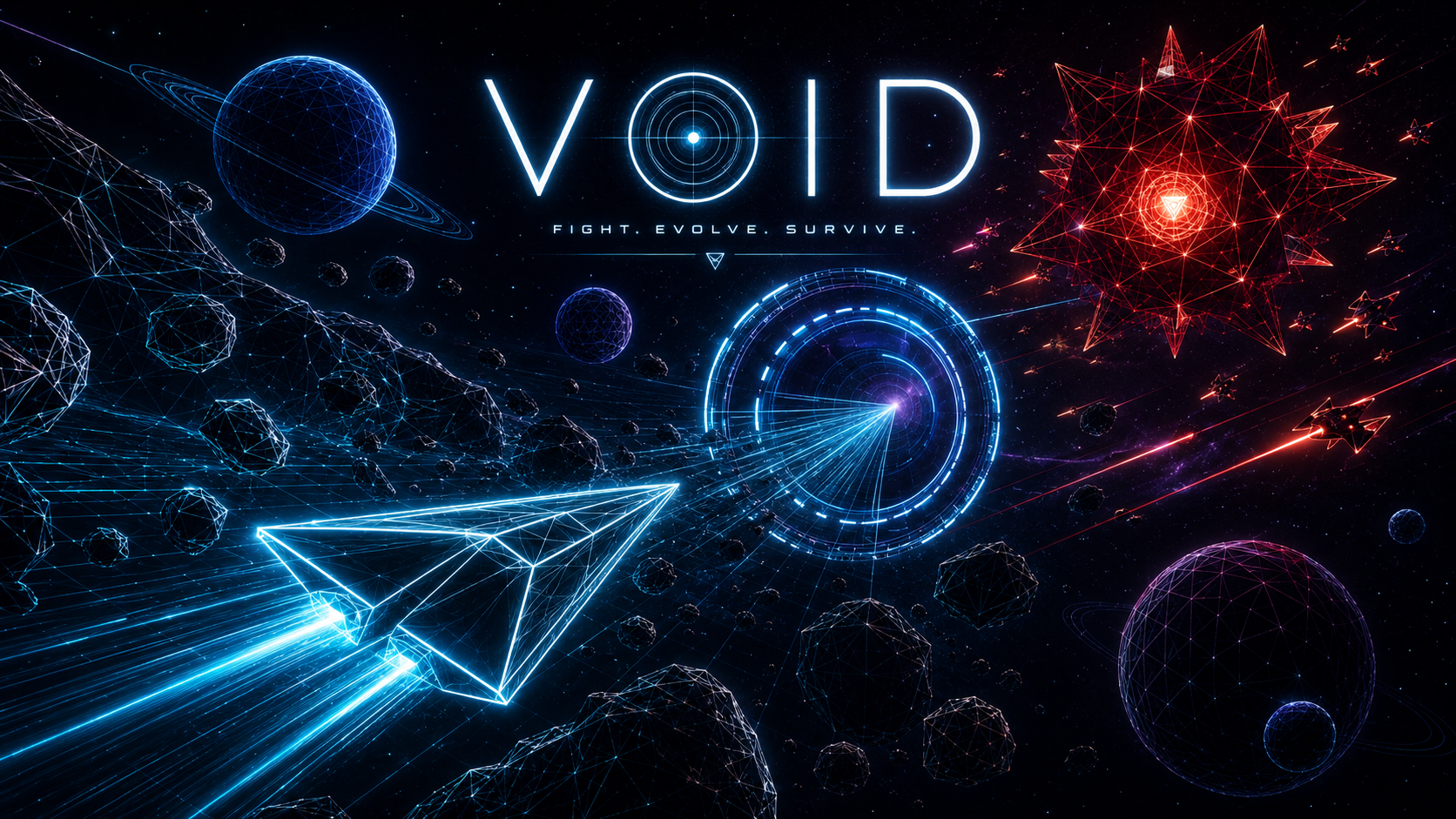
VOID is a SMMO—a Space MMO. It is a persistent multiplayer universe where pilots explore unknown systems, fight, mine, transform, communicate, and build a personal map through the places they have actually reached.
I decided to make VOID because I wanted to build a space game where movement, discovery, and survival mattered more than visual spectacle. I did not want the experience to depend on expensive cinematic assets or thousands of highly detailed models. I wanted the player to feel the momentum of the ship, the danger of entering an asteroid field, the pressure of combat, and the uncertainty of traveling into a system they had never seen before. The game needed to be exciting because of what the player could do—not simply because of what the world looked like.
Making VOID a Space MMO was central to that idea. Space becomes more meaningful when it can contain another person. A distant signal may be a stranger, an ally, a rival, or someone who simply passes through the same system before disappearing beyond a gateway. The universe persists beyond any single encounter, while discoveries, cargo, battles, and relationships give each pilot a different story inside the same shared galaxy.
The wireframe style began as a practical decision. We could not afford to hire a large team of artists to create planets, ships, characters, animations, and environments at the level expected from a major studio. Instead of allowing that limitation to stop development, we turned it into the visual identity of the game. Wireframes allowed us to construct a large galaxy with a consistent style while keeping the project efficient enough for a small team to build. What began as a limitation became one of the things that made VOID recognizable.
We made a similar decision with sound. By using free and openly available sound resources, we could spend less time and money producing temporary audio assets and more time developing the systems that actually define the experience. That meant focusing on flight, momentum, transformation, combat, mining, exploration, multiplayer interaction, progression, and the central gameplay loop. Every resource we saved gave us more room to test whether the game was genuinely fun.
The methodology behind VOID
The methodology is simple: begin with the experience, identify the systems required to create it, and make every technical or artistic decision serve those systems. Movement must feel powerful before a larger world is added. Combat must create tension before more enemies are introduced. Exploration must reward curiosity before the galaxy expands. Multiplayer must make proximity meaningful instead of existing only as a number on a server.
This project is built around efficiency over graphics. That does not mean visuals are unimportant. It means graphics should support the experience instead of replacing it. A beautiful game can still feel empty when the mechanics underneath it are shallow. I would rather create a simple wireframe asteroid that players can enter, explore, mine, hide inside, and fight around than create a perfectly rendered asteroid that only exists as decoration.
That same system-first approach shapes the SMMO. The server maintains a shared truth for movement, energy, combat, cargo, destruction, death, respawning, and travel. Systems are revealed by physically entering them. Nearby pilots can communicate because they occupy the same place, not because the universe has been flattened into a global lobby. Gateways connect the galaxy, but every crossing must be made by the player. The technology exists to protect the meaning of the journey.
The visual simplicity also gives the game room to grow. Ships, planets, enemies, gateways, caves, and entire systems can be created without abandoning the same artistic language. Light, scale, motion, color, sound, and geometry become the tools we use to make the universe feel alive. The darkness of space becomes part of the design. The player is not simply looking at the galaxy—they are uncovering it.
At the center of VOID is the belief that strong mechanics can create their own beauty. A perfectly timed turn, a dangerous warp ignition, a narrow escape through an asteroid cave, or a battle that changes because another player suddenly enters the system can become more memorable than any static visual effect. Those moments are created through systems, decisions, and player freedom.
We are not trying to pretend that VOID was created with unlimited resources. It was created because we refused to let limited resources prevent us from making something ambitious. Every constraint forced us to decide what was truly important. The answer was always the same: build the game first, make the loop satisfying, make movement feel powerful, and give players a reason to enter the darkness one more time.
VOID is not about showing players the most detailed galaxy ever created. It is about giving them a galaxy worth exploring.